.png)



If you’re looking for driver detention management software, you’re likely trying to:
- Recover detention pay that’s currently being missed, forgotten, or disputed.
- Reduce the back-and-forth between drivers, dispatchers, and accounting at job sites.
- Create a consistent way to define free time and know exactly when detention should apply.
- Tie detention directly to loads so it can be billed accurately and on time.
Many trucking companies try to manage detention using spreadsheets, driver texts, or notes on basic trucking management software (TMS). Others rely on GPS or ELD tools to identify long stops.
While these tools can highlight delays, they don’t manage detention end-to-end. In fact, we’ve found that carriers using manual processes often capture only around 40% of the detention they’re owed.
That’s because most tools only show that a driver waited. They're unable to apply free-time rules, flag detention automatically, or turn those delays into billable charges. As a result, detention is often reviewed days later, handled manually, or skipped altogether—meaning carriers don’t actually get paid for the time their drivers spent waiting.
To solve this, carriers need specialist detention management software that can automatically track arrival and departure times, flag detention when free time is exceeded, and apply detention charges directly to the order.
In this guide, we’ll show how Toro TMS helps carriers reduce delays, recover missed detention, and keep operations running smoothly for bulk haulers and short-haul trucking companies.
We’ll also briefly cover six additional tools that you can use to manage detention, so you can compare different approaches and find the best fit for your operation.
Ready to see how Toro TMS can streamline driver detention management? Book a demo today to learn more.
1. Toro TMS: Top overall driver detention management software

Toro TMS is built for local, bulk, and short-haul carriers that deal with frequent loading and unloading delays and need a reliable way to track, manage, and bill for detention without adding manual work.
For short-haul fleets, detention is a daily operational issue that directly impacts driver productivity, schedules, operating costs, and total revenue. It’s common for truck drivers to wait at multiple job sites in a single day.
When this happens, dispatchers are already focused on keeping trucks moving while accounting teams review loads days later to determine whether detention occurred. But by then, timestamps are incomplete, details are missing, and detention is often underbilled or missed entirely.
Toro TMS is designed to manage detention as part of your company’s live dispatch and billing workflow, rather than as a manual task after deliveries are completed. Our software allows carriers to identify detention in real time and recover more of the revenue they’re owed by tracking arrival and departure times, applying consistent free-time rules, and automatically tying detention to specific orders.
But any software can only automate driver detention tasks as part of a unified system that connects dispatch downstream through billing and payroll. So, below, we share how Toro allows you to:
- Assign and dispatch loads with real-time insight into driver location and availability using GPS and ELD data.
- Automatically capture detention as drivers arrive, wait, and depart from each stop, without manual tracking.
- Apply detention charges and generate invoices directly from completed load data.
- Analyze detention trends, delays, and profitability using real-time operational reports.
Read more: How to choose a dispatch software for trucking your teams will actually use
Assign new loads, track drivers, and monitor schedules in a single dispatch dashboard
When managing fleets, dispatchers have to constantly worry about tight delivery windows and drivers moving in and out of job sites while staying on schedule.
If load details, driver or truck statuses, and key order info are stored in different places, it's much more difficult to identify delays early or to determine how long a driver has been waiting once they arrive.
Toro TMS brings all key details about loads and jobs into one live dashboard, so dispatchers can see every active load, where drivers are located, and how long trucks have been on-site in real time. This centralized view makes it easier to proactively manage schedules and respond quickly when delays start to impact the day.

With Toro's live dispatch dashboard, you can:
- Assign new loads quickly using a drag-and-drop board: See which drivers are finishing stops, waiting, or approaching free-time limits before assigning the next job.
- Track on-site wait time directly from the dispatch view: Monitor how long each truck has been at a shipper or receiver so detention is accurately logged during the day.
- Adjust schedules in real-time to prevent further delays: Reassign work or change delivery sequences when a truck is held up, reducing the risk of additional detention later in the route.
- Create repeat jobs from saved load templates: Store pickup and drop-off locations, free-time rules, site notes, billing rates, and other job-specific details so repeat loads are created in seconds and detention is tracked consistently at every stop.

- Keep operations and back-office teams aligned: Since detention details are stored in the same system as dispatch, back-office teams don’t need to reconstruct delays after the fact.
Toro’s interface is user-friendly and easy for dispatchers to use throughout the day, even in fast-moving operations with constant schedule changes. With everything happening in one dashboard, teams don’t have to jump between tools or manually track timing to understand what’s happening in the field.
When dispatchers can see driver status and wait times in one place, it becomes much easier to manage detention as part of regular scheduling. That visibility helps prevent small delays from turning into missed detention and keeps the day running more smoothly.
Read more: Easy trucking software: How to pick a TMS that’s genuinely easy to use
Capture detention automatically when drivers are held at job sites
On local and regional runs, drivers often arrive at job sites early, wait in line to unload, or sit idle while crews finish prep work. When dispatch doesn’t have clear visibility into how long a truck has been waiting, it’s easy for detention time to go unnoticed until the day is already over.
Toro TMS makes detention visible while it’s happening. As drivers arrive at and depart from shipper or receiver locations, Toro automatically tracks stop-level time and shows how long each truck has been on-site.

Dispatchers can immediately see which drivers are approaching or exceeding free time without having to call drivers or watch the clock manually.
In order to make detention consistent and accurate, Toro allows carriers to:
- Turn on recommended detention settings so delays are flagged automatically instead of relying on dispatcher judgment
- Define free time by stop or customer, setting clear thresholds for when detention should apply
- Automatically apply detention fees to orders once free time is exceeded, without manual review

Because detention is identified and applied while the load is still active, it doesn’t get lost during invoicing or payroll.
With detention handled automatically throughout the day, dispatchers don’t have to guess or follow up later. Everyone works from the same real-time information, making it easier to optimize schedules while ensuring delays and detention time are accurately accounted for.
Read more: Dump truck software: 5 top choices for specialist software
Send drivers real-time job updates and collect documents digitally to prevent delays and disputes
Collecting accurate documentation and maintaining communication between drivers and dispatchers is necessary for efficient detention management. When drivers don’t have the latest job details (or when arrival and departure times aren’t properly documented), delays turn into disputes, and detention charges become harder to justify.
In many fleets, drivers still rely on phone calls or paper notes to confirm when they arrived, who they spoke to, or why they were held up. By the end of the day, those details are incomplete or forgotten, leaving dispatch and accounting teams without the documentation needed to support detention.
Toro TMS simplifies this by sending job details directly to drivers and giving them an easy way to upload documentation from their phone—no app downloads or logins required.

When a load is assigned or updated, drivers receive a text message that includes:
- Pickup and delivery locations
- Appointment times or delivery windows
- Site-specific instructions (such as check-in procedures or unloading time rules)
- Key notes about delivery sites (such as restricted access hours)
- Any special instructions related to loading or unloading delays
That same message includes a secure link where drivers can upload documentation tied to the load. This documentation is used by back-office teams for billing, payroll, and other accounting tasks.
This could include:
- Arrival and departure confirmations
- Photos of gate logs, sign-in sheets, or loading dock paperwork
- Time-stamped notes explaining delays at the job site
- Signed delivery receipts or proof-of-delivery forms
- Any documentation required to support detention charges

Once submitted, Toro automatically attaches all documents and notes to the correct load. Dispatchers can see updates in real time, and back-office teams have a complete, time-stamped record to support billing and payroll.
Read more: Trucking ticket management software: How to better manage your paper tickets
Cut back-office work by automating invoicing and payroll tasks
Detention creates extra back-office work for both dispatchers and back-office staff, especially when it's not handled automatically.
After a load is completed, teams still need to confirm arrival and departure times, determine whether free time was exceeded, calculate detention charges, and make sure those charges are reflected on the invoice and driver pay.
When that workflow is manual, detention is easy to miss, and billing teams end up chasing drivers and dispatchers for the details needed to support charges.
Toro reduces that workload by carrying detention data through the same workflow as dispatch and billing. The system captures timing and detention flags during the job, so there's no need to reconstruct what happened after the fact.
This helps carriers invoice faster, pay drivers accurately, and capture more detention revenue without adding admin overhead. Many carriers report cutting billing and payroll admin time by up to 70% after switching to Toro.

On top of that, Toro allows you to:
- Apply detention charges automatically when free time is exceeded: Detention is flagged in the system and added to the order without requiring manual review or calculation.
- Generate invoices faster using completed load data: Invoices pull from the same load record used in dispatch, including stop details, timing, and accessorial charges like detention.
- Reduce payroll errors by using the same job data for driver pay: Driver pay calculations can flow from completed load activity, so accounting teams aren’t rekeying details or reconciling separate spreadsheets.
- Eliminate repeat data entry across teams: Because dispatch, detention tracking, documentation, and billing live in one system, back-office staff spend less time chasing missing information or correcting inconsistent entries.
- Keep detention documentation organized for disputes: Timing records and supporting notes or documents stay attached to the load, making it easier to justify charges and resolve pushback quickly.
Read more: Trucking accounting software: 5 best options to streamline back-office tasks
Identify detention trends, profitability, and recurring issues with real-time reporting
Toro TMS gives carriers real-time visibility into the operational and financial impacts of delays, helping you understand where detention occurs, how often it happens, and what it’s costing your business.
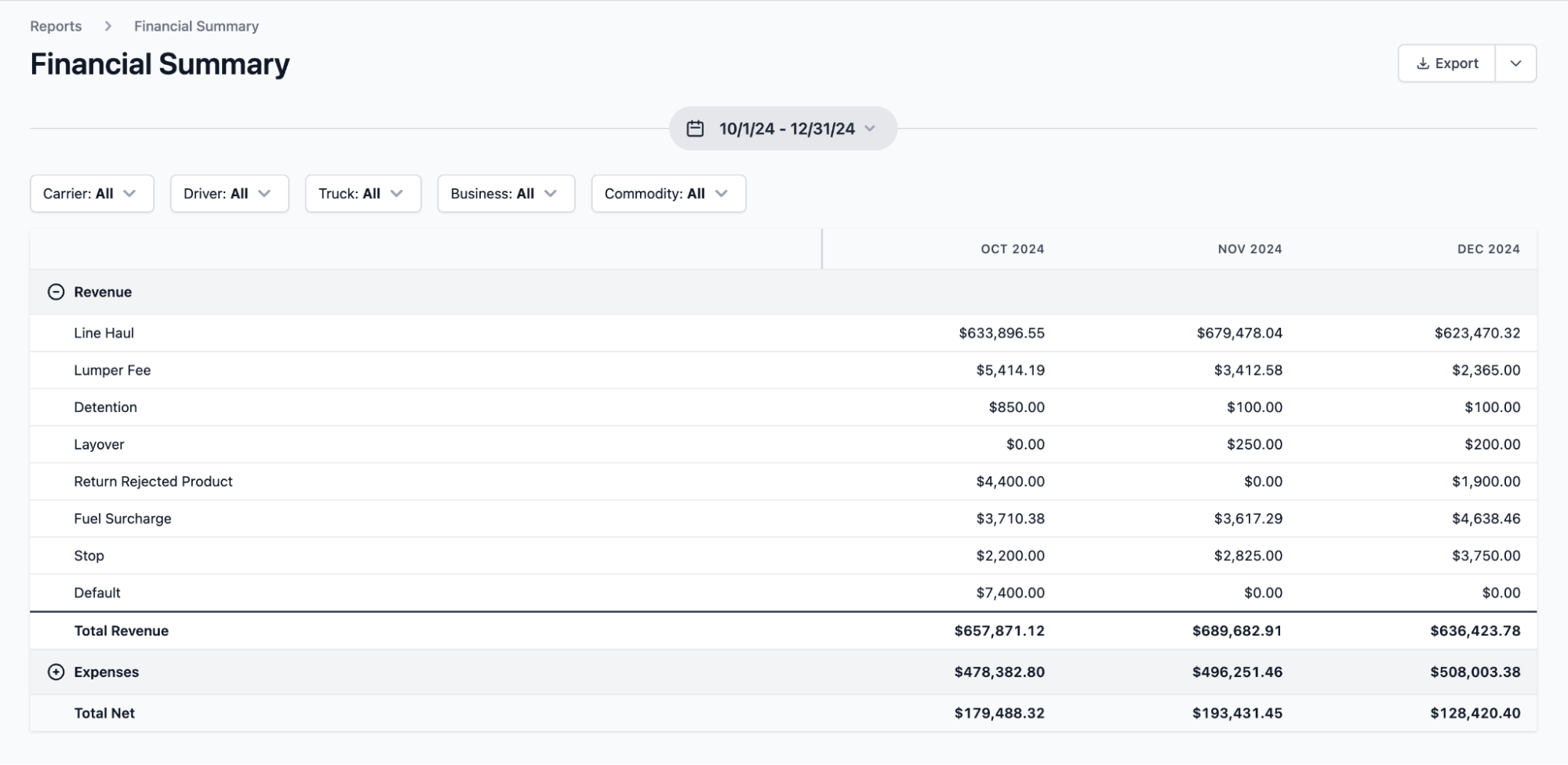
Managers can review detention in real-time to see patterns as they develop and take action to prevent repeat issues. With Toro's reporting, you can:
- Analyze detention by job site, customer, and stop type: See which shipper or receiver locations consistently hold drivers beyond free time and how often detention is triggered. For example, Toro can highlight sites where unloading regularly exceeds two hours, helping you adjust schedules or renegotiate terms.
- Understand the profitability impact of delays: Compare loads that ran on schedule against those affected by detention to see how wait time impacts margins. You can quickly identify jobs where detention charges offset delays and those where drivers lost productive hours without compensation.
- Spot recurring issues in daily operations: Use timestamp data to uncover patterns such as morning congestion at specific sites or routes that consistently lead to idle time and other inefficiencies.
- Track driver and equipment utilization alongside detention: See how long trucks and drivers are tied up waiting instead of hauling. Toro’s reports help you identify underutilized assets caused by delays and adjust dispatch plans using clear performance metrics tied directly to detention.
- Use historical data to reduce future detention: Review past detention trends to plan more accurate delivery windows, allocate the right number of trucks, and set realistic expectations for similar jobs in the future.
Read more: Aggregate dispatch software: 5 top options for bulk haulers
Adopt the platform quickly with dedicated onboarding and support
Rolling out new software can be disruptive, especially when dispatchers, drivers, and back-office teams aren't technically savvy, or they’re already busy with day-to-day tasks.
Many software platforms only provide self-serve training and documentation, which can make it difficsouult to learn the system and integrate it into your workflow.
Toro TMS uses a hands-on onboarding approach to make sure your team is set up correctly from day one. Our onboarding specialists work directly with your dispatchers, drivers, and office staff to configure workflows, review real-world scenarios, and ensure that features such as detention tracking, load management, and billing are used consistently.
Once you’re live, Toro’s support team is available to help resolve questions quickly, without slowing down dispatch or billing. The system is designed to be intuitive for users at every level, so teams can adopt it confidently without extensive technical training.
Support requests are answered within 30 minutes, from 9 a.m. to 9 p.m. ET, helping your operation stay on schedule when issues arise.
Reduce the time you spend managing detention. Book a demo to see how Toro TMS can help.
6 alternative driver detention management software options
If you're not sure about Toro TMS or whether it's the right fit for your operation, here are six additional software solutions that can help carriers manage driver detention.
1. Trimble TMW
Trimble TMW is an enterprise TMS that supports carriers with complex dispatch, billing, and contract requirements. The tool offers rule-based detention management through configurable free-time allowances, event triggers, and accessorial charge automation tied to customer contracts.
When properly configured, Trimble TMW can automatically calculate detention based on arrival and departure events and apply detention charges during billing. However, implementation typically requires significant setup and ongoing administrative costs, which are best suited to large fleets with dedicated operations and IT teams.
Key Trimble TMW features include:
- Contract-based detention and accessorial rules
- Event-driven workflows using stop timestamps
- Automated detention charge calculation during billing
- Deep dispatch, settlement, and accounting integration
- Enterprise reporting and analytics tools
2. McLeod Software

McLeod Software is an enterprise TMS used by larger carriers with complex dispatch, accounting, and compliance requirements. It offers highly configurable workflows that can support detention tracking based on customer-specific rules and contracts.
Companies can use McLeod to manage detention at scale, but setup and ongoing administration often require dedicated resources. It's a more complicated and expensive platform that won't suit small or regional carriers.
Key McLeod Software features include:
- Advanced dispatch and load planning tools
- Configurable FTL detention and accessorial rules
- Integrated accounting, billing, and settlements
- Contract-based pricing and customer rule management
- Enterprise reporting and analytics
Read more: McLeod Software competitors: 7 alternatives for trucking companies
3. Samsara
Samsara is a fleet operations and telematics platform that gives carriers real-time visibility into vehicle locations, stop durations, and dwell time. Many carriers use Samsara data to identify when drivers are delayed at shipper or receiver locations.
While Samsara helps identify detention events through GPS and timestamp data, detention billing and charge automation typically happen outside the platform (often in a TMS or accounting system).
Key Samsara features include:
- GPS-based arrival and departure tracking
- Dwell time and stop duration reporting
- Real-time fleet visibility and alerts
- Driver mobile apps and ELD functionality
- Integrations with TMS and back-office systems
Read more: How to choose the best TMS software for carriers: Top 7 options
4. Tailwind TMS
Tailwind TMS is a cloud-based transportation management system built for small to mid-sized carriers. It provides core dispatch, load tracking, and billing tools in a relatively simple-to-use interface.
Detention can be tracked and billed within Tailwind, but the process is usually handled manually. Dispatchers or accounting teams must review loads after completion to identify detention and apply charges.
Key Tailwind TMS features include:
- Dispatch and load management tools
- Stop tracking with basic detention fields
- Invoicing and customer billing workflows
- Driver settlements and payroll support
- Reporting for operational performance
5. Tenstreet

Tenstreet is a driver recruiting and lifecycle management platform focused on hiring, onboarding, compliance, and driver engagement. It’s widely used by carriers to manage the driver side of their operations rather than dispatch or billing.
Tenstreet is not a dedicated detention management solution, but carriers can use driver communication and time-related data to support detention workflows when integrated with a TMS or telematics platform.
Key Tenstreet features include:
- Driver recruiting and onboarding tools
- Driver communication and engagement platforms
- Compliance and safety management features
- Integrations with TMS and telematics providers
- Driver data and performance reporting
6. Add On Systems

Add On Systems (AOS) is a TMS for small and mid-sized trucking companies. It supports dispatch, load tracking, and billing workflows that allow carriers to manage detention as part of their invoicing process.
Detention tracking in Add On Systems is typically manual and handled during post-load billing, rather than being automatically flagged in real time.
Key Add On Systems features include:
- Dispatch and load management tools
- Manual detention and accessorial charge entry
- Integrated invoicing and settlements
- Customer and contract management
- Operational and financial reporting
Automate your driver detention management with Toro TMS
Managing driver detention means balancing driver schedules and predicting job-site delays that impact productivity and revenue. Toro TMS brings detention management into one connected system from dispatch through billing.
With Toro TMS, you can:
- Identify detention in real time by tracking arrival and departure times at every stop.
- Apply consistent free-time rules so detention is flagged accurately across loads and customers.
- Automatically bill detention and calculate driver pay using completed load data, without manual review.
- Reduce detention disputes with clear, time-stamped records tied directly to each load.
- Keep dispatch, billing, and reporting connected in one system for complete visibility into delays and their impact on profitability.
Book a demo to see how Toro TMS captures more detention without more manual work.