.png)




If you're looking for a dairy transportation management system, you likely already know that hauling raw milk isn't like hauling standard freight.
Dairy haulers face a broader range of challenges, including strict food safety requirements and highly time-sensitive pickups from farms to processing plants. On top of that, daily milk volumes fluctuate and multi-stop routes are common, so even small delays can result in missed delivery windows or spoiled product.
Most traditional transportation management systems (TMSs) are built for dry freight and general trucking operations. As a result, they don’t account for the operational complexities of dairy hauling, like coordinating multiple farm pickups, matching the right equipment to each load, or tracking time-sensitive deliveries.
At the same time, these tools can become overly complex for dispatchers and drivers to use in fast-moving, field-based operations. And in our experience, that complexity usually results in dispatchers and drivers abandoning the software and reverting back to manual spreadsheets and phone calls. This commonly leads to scheduling errors, dock congestion at processing plants, billing disputes, and unnecessary detention costs.
If you want a dairy TMS that actually works for your operation, look for a platform that can:
- Create and dispatch milk loads fast from one central dispatch board, without dispatchers having to switch between screens or build new loads from scratch every time.
- Collect BOLs, delivery confirmations, and compliance records right from the driver’s phone so your team isn’t stuck waiting on paperwork to close out loads.
- Show real-time driver and tanker locations with accurate ETAs, so dispatch can stay ahead of delays.
- Generate accurate invoices and driver settlements automatically, using data that's already in the system.
- Analyze fleet performance with advanced reports that break down revenue, costs, and profitability by truck or route.
In this article, we’ll show how dairy haulers can run their operations more efficiently with Toro TMS, then cover four additional dairy TMS options worth considering.
Book a demo to see Toro in action and find out if it's the right fit for your dairy hauling operation.
1. Toro TMS: The best overall TMS for bulk dairy haulers

Toro TMS is built to support bulk hauling operations—including fleets that move raw milk and dairy products between farms and processing plants.
Our software gives teams in the dairy industry the tools they need to manage dispatch, cut down on paperwork, track detention at plants, and process billing faster using completed load data.
That's possible because Toro centralizes all load details in one system. When a new load is created in Toro’s dispatch screen, all related details—such as farm stops, plant delivery locations, tanker assignments, rate structures, detention rules, and delivery statuses—are available throughout your entire organization.
Below, we'll show you how Toro supports dairy transportation teams by helping you:
- Create recurring loads in seconds using pre-built job templates
- View all active pickups, deliveries, trucks, and drivers in one live dispatch board
- Capture relevant delivery paperwork digitally and communicate directly with drivers via text message
- Automate invoicing and driver settlements based on how dairy hauling is actually priced
- Generate reports to see which customers are profitable and which drivers are more efficient
To see these features in action, book a demo right away.
Create repeat dairy loads in seconds using reusable job templates
Most dairy hauling operations run the same farm-to-plant routes day after day. Typically, the farms and processing plants are the same, the pickup windows are similar, and the rate structure doesn’t change much week to week.
But many dispatchers still rebuild each load from scratch, re-entering the same farm details, delivery locations, tanker requirements, and billing rules every time. It's also more likely that dispatchers abandon the software if they feel it's too complicated or time-consuming to use.
Toro TMS solves this by providing dispatchers with reusable load templates that allow them to create new orders instantly. They can select a saved template and create a new load in seconds without retyping the same details each time.

Dairy transport companies can use these load templates to store:
- Farm pickup locations and typical pickup windows for each stop
- Processing plant delivery locations and dock appointment preferences
- Tanker type, capacity, and sanitation requirements (like wash-out rules between runs)
- Reference fields for processor IDs, lot numbers, or contract terms
- Additional notes for drivers (gate access instructions, contact info, time-sensitive handling requirements)
For example, if you run a regular Monday and Thursday pickup from the same three dairy farms to the same processing plant, you can save that entire route as a single template. In the template, you can include details such as the location, tanker size, the contracted haul rate, and any farm-specific notes like "use rear gate entrance" or "call ahead 30 minutes before arrival."
After a load is built from a template, all of that information automatically flows downstream into dispatch views, driver instructions, billing, payroll, and reporting. This means nothing has to be re-entered manually, and your back office always has accurate load data to work from.
Read more: How to choose a dispatch software for trucking your teams will actually use
Manage farm pickups, plant deliveries, and equipment assignments from one centralized dispatch dashboard
In dairy hauling, timing is important because raw milk has such a narrow window from farm pickup to plant delivery. If a tanker is running late, sitting idle at a receiving dock, or assigned to the wrong route because a dispatcher didn't have full visibility into the fleet, you're risking lost time or, worse, a rejected load.
That’s why, if you force your dispatchers to switch between tools to manage the process, it can be difficult to make adjustments when things change.
Toro TMS consolidates farm pickups, plant deliveries, drivers, and tanker assignments into a single dispatch screen. This allows you to assign new loads, monitor driver statuses, and make adjustments to existing schedules without needing manual updates from drivers.

In Toro's dispatch dashboard, you can:
- Assign drivers and tankers to new loads using a drag-and-drop interface: Match drivers and available tanker capacity to each farm-to-plant route on a single screen. Dispatchers can quickly balance loads across the fleet during peak pickup windows without flipping between schedules or spreadsheets.
- Adjust routes and load details in real time: If a farm’s pickup volume comes in higher or lower than expected, dispatchers can update load details or reassign equipment without rebuilding a load. Those changes sync automatically to driver instructions, billing, and reporting, so the back office isn’t working off outdated information.
- Track in-progress pickups and deliveries with live location data: See where each truck is on its route, which farm stops are completed, and which deliveries are still in progress. This makes it easier to anticipate delays and communicate accurate ETAs to processing plants.
Because Toro’s dashboard is genuinely easy to use, dispatchers spend less time navigating screens and more time managing drivers and schedules.
Read more: Dispatch management software: 3 questions to ask to choose the right tool
Allow drivers to receive load details and upload documentation digitally while on the road so back office teams aren't waiting on paperwork
Dairy hauling depends on accurate documentation for nearly every load, including bills of lading at pickup, scale tickets at processing plants, delivery confirmations, and temperature or chain-of-custody records required by processors and food safety audits.
When those documents don’t make it back to the office quickly, important back-office tasks like invoicing and driver pay get delayed.
Toro TMS allows drivers to receive load details and submit documentation digitally while they’re still on the road—without forcing them to download an app or manage online logins.
After a load is built and assigned, Toro automatically sends the driver a text message with all relevant pickup and delivery details. That message includes a secure link where the driver can:
- View farm-by-farm pickup instructions, gate access notes, and plant delivery windows before arriving on site
- Snap photos of BOLs, scale tickets, delivery confirmations, and temperature or chain-of-custody records
- Submit all required load paperwork from the cab as soon as deliveries are completed

Toro also lets dispatchers schedule text messages in advance when they build loads every morning. That means they can easily plan out the day’s farm pickups and plant deliveries at once, and drivers automatically receive their load details as routes are assigned.
Once drivers submit their documents, Toro extracts key details like load references, delivered volume, pickup and drop-off times, and trailer IDs, and syncs them to the correct load. This makes it easier for back-office teams to send invoices and process settlements faster without retyping any info or chasing drivers for lost paperwork.
Read more: Trucking ticket management software: How to better manage your paper tickets

Save up to 70% of the time your team spends on back-office administrative tasks
Once a milk load is delivered, your back office still has to calculate driver pay, generate invoices for processors or cooperatives, reconcile volumes and mileage, and store documentation for food safety audits and customer disputes.
Toro streamlines this entire process by turning completed load data into ready-to-process billing, payroll, and compliance records, cutting the time spent on administrative tasks by up to 70%.

With Toro, you can:
- Quickly generate customer invoices: As soon as drivers upload BOLs and delivery confirmations from the field, Toro pulls key load details (like pickup locations, delivered volume, mileage, and delivery times) directly into customer invoices. You can bill individually or in batches without rebuilding invoices in spreadsheets.
- Automatically calculate driver pay in seconds: Driver settlements are generated from completed load data based on your pay structure (by mile, by volume, by hour, or a combination of various pay structures) that includes detention or wait time at plants. Each driver’s profile stores custom rates and adjustments, so payroll doesn’t require manual calculations after every delivery.

- Automate mileage and fuel tax reporting: Toro’s ELD integrations capture route and mileage data automatically, so it's much easier to prepare accurate fuel tax and mileage reports without manual logs. This reduces time spent on manual calculations, reporting errors, and simplifies compliance across jurisdictions.
- Sync all financial information with QuickBooks: Invoices, settlements, and tax data can be pushed directly to QuickBooks Online or Desktop with mapped fields. As a result, accounting records are kept clean and audit-ready without re-entering the same data in multiple systems.
- Centralize compliance and delivery records: All pickup logs, delivery confirmations, and supporting documents are stored digitally and tied to the correct load. When processors request documentation or audits occur, your team can pull records instantly instead of manually searching through paper tickets for the right information.
Read more: Driver detention management software: 7 top tools for carriers
Uncover critical business insights with advanced reporting tools
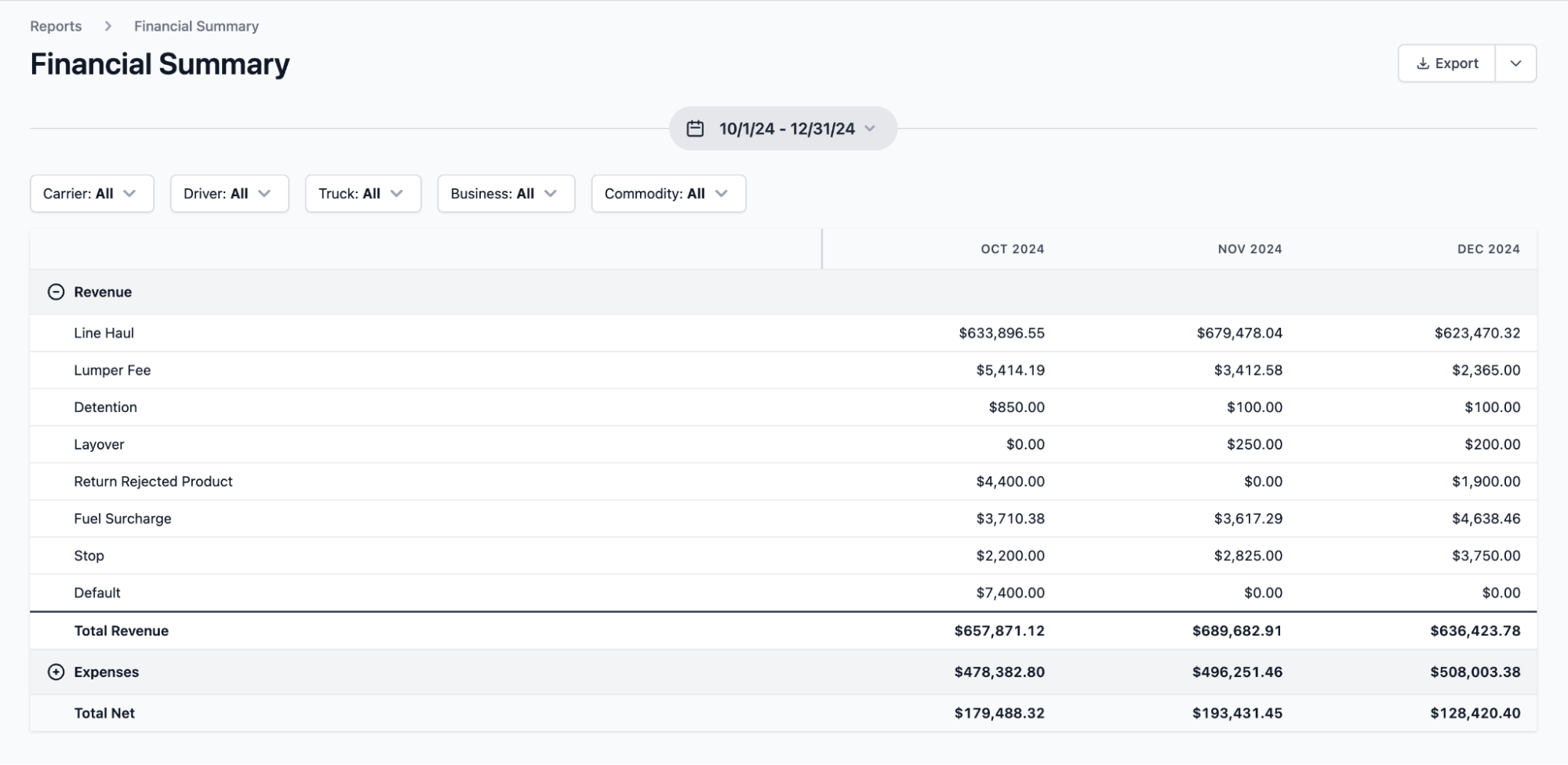
Toro TMS gives dairy companies real-time visibility into what’s actually happening across farm pickups, processing plant deliveries, and overall fleet operations.
With Toro’s reporting and analytics, teams can:
- Analyze profitability by route, processor, driver, or equipment type: Break down revenue and costs by specific farm-to-plant lanes using real-time data to see which routes are profitable and which are being eaten up by detention time or inefficient routing. For example, if you're running a farm pickup route three times a week but the fuel and driver costs consistently outpace the haul rate, Toro surfaces that so you can renegotiate the rate or restructure the route.
- Identify detention and dock congestion patterns at processing plants: Use delivery timing and wait-time data to see which plants consistently cause delays. With this data, you can better renegotiate detention terms and adjust scheduling to avoid multiple trucks at the same dock during peak hours.

- Compare equipment utilization across tanker types and capacities: Segment performance by trailer or tanker type to understand which equipment configurations are driving better utilization and margins. This helps teams make more informed decisions about whether certain routes need different capacity tankers or whether underutilized equipment is creating hidden milk transportation costs.
- Evaluate driver and route efficiency side by side: View mileage, load volume, turnaround time, and empty return miles in one place to find opportunities to reduce deadhead miles. For instance, you can compare two similar milk routes and see why one consistently finishes faster with fewer idle hours.
Read more: Trucking accounting software: 5 best options to streamline back-office tasks
Ensure your team adopts the software with hands-on training and in-person onboarding
Switching software is hard enough in any business. But for dairy haulers, it can be even more challenging. That's primarily because pickups can't wait and dispatchers are already stretched thin, so there's no room for a lengthy implementation process.
Many TMS solutions will simply provide you with login credentials, help center contact details, and a few tutorial videos—leaving your team to figure it out on their own.
Toro takes a different approach. When you come on board, we send someone to your office to work alongside your team in person. We train each department—dispatch, drivers, and accounting—on the specific features they'll actually use, so no one is unsure of how things work day-to-day.
The platform is easy to learn, and once you're up and running, our support team is there to answer any questions. You'll typically get responses to any inquiries within 30 minutes between 9 a.m. and 9 p.m. ET.
See if Toro is the right fit for your dairy fleet—book a free demo today.
4 Alternative dairy transportation management systems worth considering
1. M2X Group

M2X is a cloud-based TMS built for specialized bulk hauling industries, including dairy, livestock, and bulk commodities. It includes features for farm milk collection, plant scheduling, hauler settlements, and by-product transport.
It's best suited for mid-to-large dairy hauling companies and processors, particularly those managing complex multi-farm, multi-plant operations.
Key features include:
- Farm milk production forecasting to estimate load-ready times and match supply to plant demand
- Driver mobile app for real-time pickup updates and status changes
- Plant scheduling and ETA dashboards to manage incoming loads
- Detention tracking and automated hauler settlements
- Automated invoicing and freight rating
Read more: Livestock transportation management software: How to transport live cargo
2. MADCAP Dairy Software
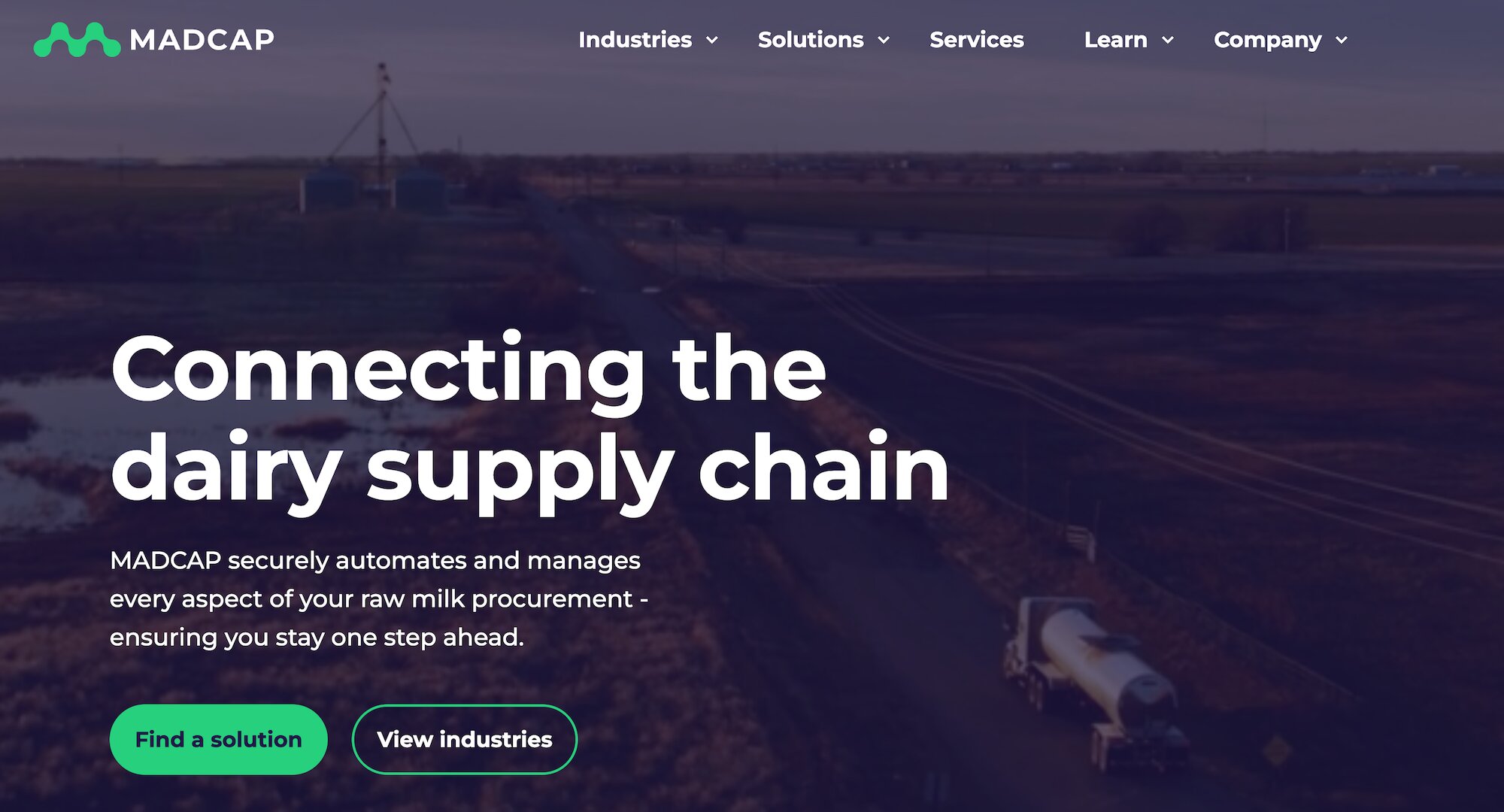
MADCAP is an enterprise dairy supply chain platform with built-in tools for dispatch, accounting, quality testing, and producer management.
It's useful for large haulers, but for smaller independent haulers primarily focused on dispatch, billing, and fleet operations, it may be more platform than you need.
Key features include:
- Scheduling, dispatch, and route optimization for milk collection and tanker fleet management
- Real-time monitoring of raw milk load temperatures, volumes, and truck locations
- Hauler mobile app for on-the-go visibility and load documentation
- Hauler payroll and customer billing with automated payment processing
- Quality and laboratory management integrated directly with transport data
- ESG and compliance reporting
3. Ever.ag

Ever.Ag is a dairy supply chain platform providing transportation management software with consulting services. This includes managed dispatch services, hauler rate benchmarking, and plant intake optimization.
It's a good fit for large processors and cooperatives, but probably too complicated for independent haulers and regional milk carriers that need simplified dispatch functions and basic trucking modules.
Key features include:
- Farm-to-plant haul cost modeling to accurately price every route
- Plant-to-plant procurement with rate benchmarking based on a network of over 2,000 tanker haulers
- Turn truck optimization tools to reduce plant intake delays and dock congestion
- Dispatch and payroll managed services for cooperatives
- Supply chain strategy consulting to benchmark end-to-end hauling performance against industry peers
4. Milk Moovement

Milk Moovement is a milk supply chain platform built specifically for dairy cooperatives to coordinate milk collection, hauler dispatch, quality tracking, and producer payments in one place.
Its recently launched AI scheduling tool, Moove, automatically optimizes routes and load assignments based on variables like cost and milk tanker capacity. This gives dispatchers better visibility into dairy logistics operations and helps improve decision-making around route planning, load balancing, and hauler utilization.
Key features include:
- Route planning and AI-powered scheduling optimization
- Real-time tracking with live driver location and route status updates
- Quality and lab integration to connect test results directly with transport and pickup data
- Automated pay reporting for hauler settlements and producer payments
- Custom reporting and client portals
Toro TMS: The best dairy transportation management system for bulk haulers
The transportation management system you choose should actually match how your operation runs. For bulk milk haulers, that means managing recurring farm pickup routes and coordinating tight delivery windows to processing plants. Plus, you want to keep dispatchers, drivers, and back-office staff aligned without adding more complexity to an already demanding job.
Toro TMS was built to make this entire process easier. It brings your dispatching, driver communications, and back-office workflows into one centralized system.
With Toro TMS, dairy haulers can:
- Create and dispatch recurring loads in seconds using saved job templates.
- Track every tanker, driver, and delivery in real time from a single dispatch screen.
- Allow drivers to receive load details and submit BOLs and delivery confirmations directly from their phone.
- Automate invoicing and driver settlements from completed load data.
- Track performance and profitability with specialized reporting tools that identify your most efficient drivers and customers.
Ready to see how Toro TMS can work for your dairy fleet? Book a free demo today.